



Blog
Crusher Selection Guide: Jaw, Cone or Impact?

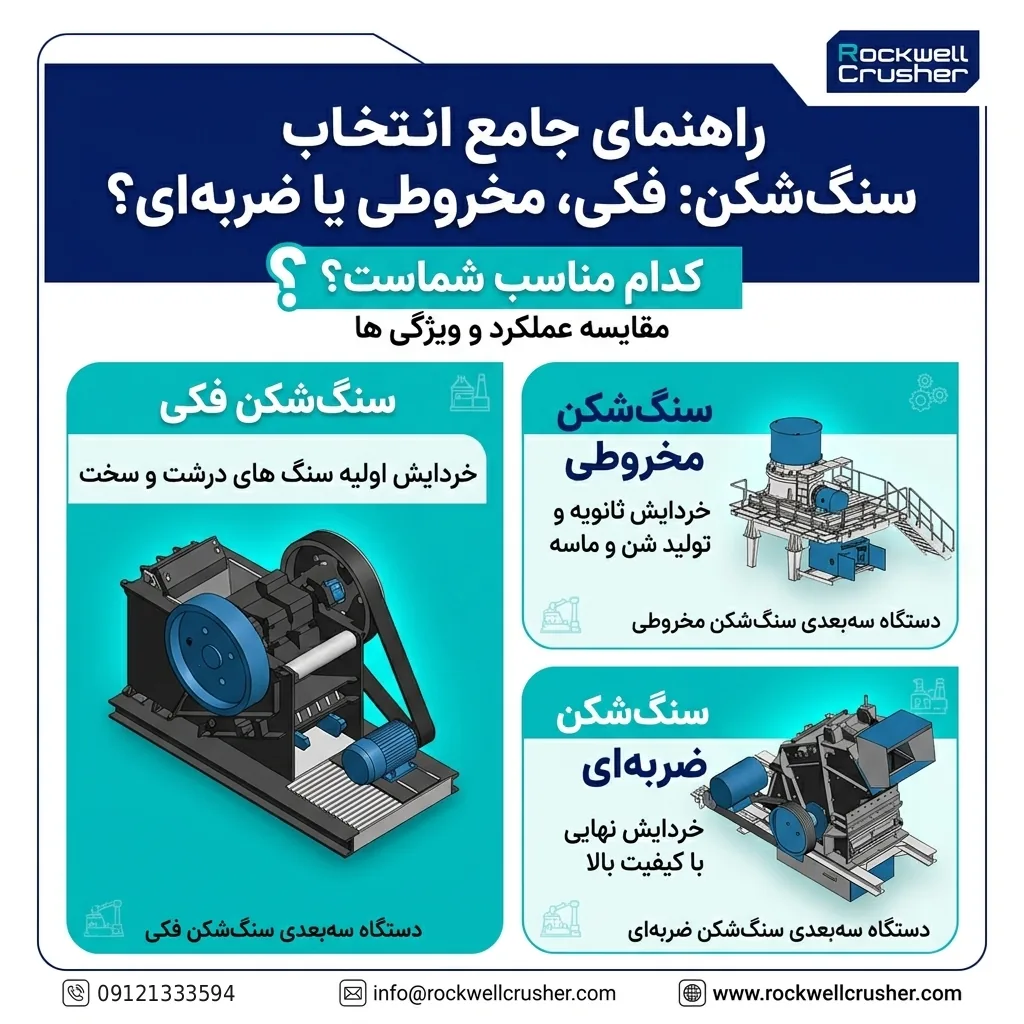
Choosing the right crusher is one of the most important decisions when setting up a sand and gravel production line. A machine that doesn’t match the rock type and project capacity either fails to reach its rated capacity or its wear-part replacement costs get out of control. In this guide we compare the three main types of crushers — jaw, cone and impact — so you know which one suits which conditions.
Crushing Stages in a Crushing Line
In most production lines, rock does not reach its final size in a single stage. Crushing is usually done in several stages:
- Primary crushing: large rocks coming straight from the quarry are broken into smaller pieces.
- Secondary crushing: pieces from the first stage are crushed to medium sizes close to the final product.
- Final crushing and sand making: fine aggregates and sand with the right quality and shape are produced.
Each type of crusher is designed for one or more stages of this process. So the right question is not “Which crusher is best?” but “Which crusher suits which stage and which rock?”
Jaw Crusher
A jaw crusher consists of two steel jaws: one fixed and one moving. The moving jaw, with a back-and-forth motion, presses the rock against the fixed jaw and breaks it. This compression crushing method makes the jaw crusher a reliable choice for primary crushing.
Advantages: accepts very large rocks, simple and robust structure, suitable for hard and abrasive rock, and relatively low maintenance cost.
Limitations: output grains are usually less cubical, and a further crushing stage is needed to produce the final product.
Rockwell Crusher single-toggle jaw crushers are built in five models, with capacities of 60 to 900 t/h and feed sizes up to 1000 mm. Their wear parts are made of manganese steel.
Cone Crusher
In a cone crusher, a steel cone rotates eccentrically inside a bowl and crushes the rock between itself and the bowl wall. This machine also works by compression, but it is designed for secondary and final crushing.
Advantages: suitable for hard and abrasive rock, better grain shape than a jaw crusher, long wear-part life and low operating cost over time.
Limitations: the feed size is more limited, and it usually has to be placed after a primary crusher.
Rockwell Crusher produces cone crushers in 36-inch and 45-inch models. The 36-inch models have a capacity of 80 to 170 t/h.
Impact Crusher
An impact crusher uses impact instead of compression to break rock. A rotor spins at high speed and its blow bars throw the rock against impact plates. On impact, the rock breaks along its natural cracks.
Advantages: high reduction ratio, cubical grain shape suitable for concrete and asphalt, and adjustable grading by changing the gap of the impact plates.
Limitations: with very hard and abrasive rock (high silica), parts wear faster and blow bar replacement costs increase. This machine performs best on medium-hard rock such as limestone.
The Rockwell Crusher impact crusher (model ICA-120) has a capacity of 100 to 120 t/h and is equipped with a hydraulic system for opening the housing, making parts replacement quick and easy.
VSI crusher for sand making: if your main goal is to produce high-quality sand, the vertical shaft impact crusher (VSI) is the specialized machine for the job. It throws fine aggregates at high speed against the wall and produces sand with cubical grains. The Rockwell Crusher VSI-900 has a capacity of 250 to 300 t/h.
Quick Comparison of the Three Crusher Types
| Feature | Jaw | Cone | Impact |
|---|---|---|---|
| Crushing method | Compression | Compression | Impact |
| Suitable stage | Primary | Secondary and final | Primary to final |
| Suitable rock | Hard and abrasive | Hard and abrasive | Medium-hard, low abrasion |
| Feed size | Very large | Medium | Medium to large |
| Output grain shape | Less cubical | More cubical | Cubical |
| Wear cost in hard rock | Low | Low | High |
Which Factors Determine Crusher Selection?
- Rock hardness and abrasiveness: hard, siliceous rock such as granite and river stone is usually crushed more economically with compression crushers (jaw and cone). Medium-hard rock such as limestone is a good fit for impact crushers.
- Feed size: the largest rock entering the line from the quarry determines the type and size of the primary crusher.
- Required capacity: the capacity of each machine must match the total line capacity and the machines before and after it.
- Final product: concrete gravel, building sand and asphalt aggregates each require a different grading and grain shape.
- Moisture and soil with the rock: wet or clay-laden rock may cause clogging in some machines and may require a grizzly feeder or a washing stage.
- Operating cost: the purchase price is only part of the cost; energy consumption and wear-part replacement over the years matter more.
Common Combinations in Production Lines
In practice, most lines use a combination of several crusher types:
- For hard quarry rock: a jaw crusher in the first stage, a cone crusher in the second stage and, if needed, a VSI for sand making.
- For limestone and medium-hard rock: a jaw crusher in the first stage and an impact crusher for secondary crushing and producing cubical aggregates.
Tip: the best choice is not possible without a precise understanding of the rock and the project’s needs. Before buying, review the rock specifications (type, hardness, feed size), the required capacity and the final product with an expert.
Related articles: Gyratory crusher buying guide and What is a roll crusher?
Consult Us to Choose the Right Crusher
Based on your rock type, capacity and desired final product, Rockwell Crusher’s experts will recommend the right machine or production line.