



Blog
Gyratory Crusher: Buying Guide, Difference from Cone Crushers and Price Factors

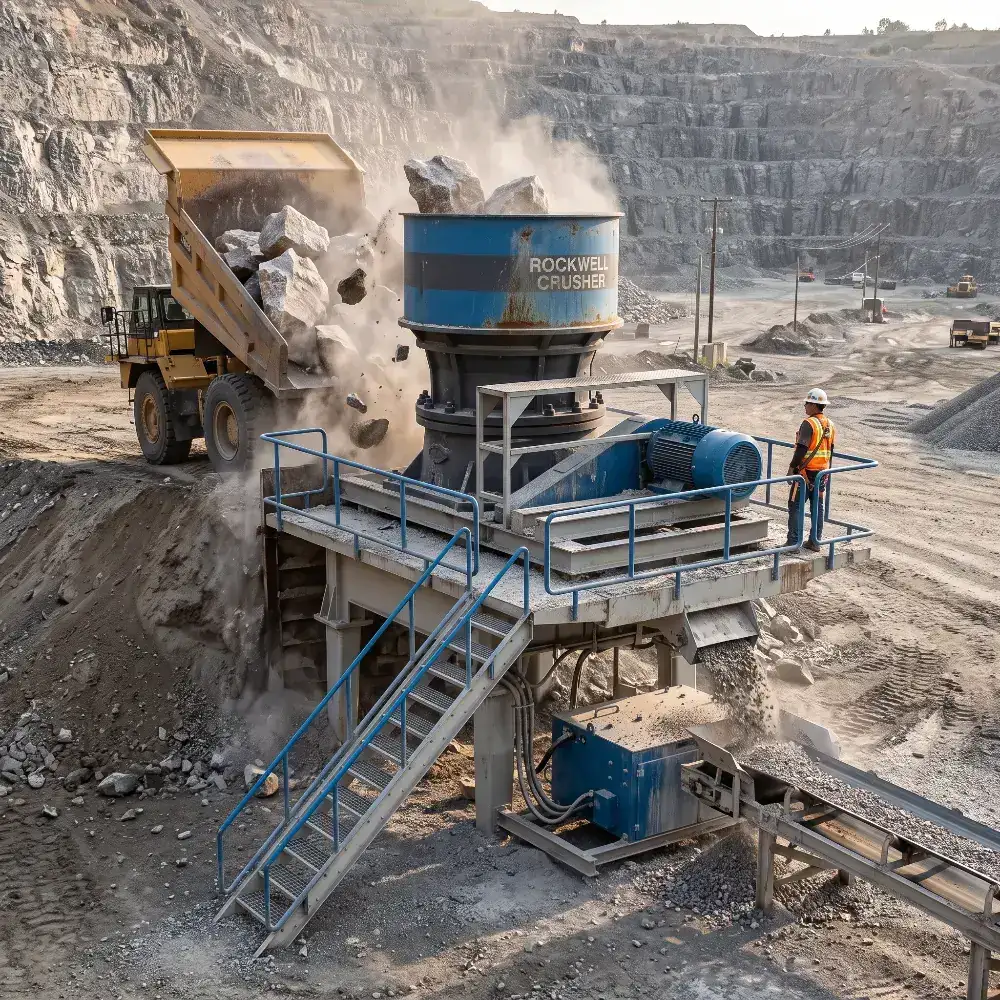
The gyratory crusher is one of the most widely used machines for crushing hard rock in sand and gravel production lines and in mines. If you are planning to buy a gyratory crusher, before asking for a quote you should know how this machine works, how it differs from a cone crusher, and which factors affect its price. In this guide we explain all of these in plain language.
What Is a Gyratory Crusher and How Does It Work?
In a gyratory crusher, a cone-shaped part called the “mantle” sits inside a fixed shell called the “concave”. The main shaft rotates with an eccentric (gyratory) motion, so at any moment the mantle moves closer to one side of the concave and away from the other. Rock enters the crushing chamber from the top and is squeezed and broken between the mantle and the concave; the lower it goes, the finer it gets, until it leaves through the discharge opening. Because crushing takes place continuously all the way around the machine, the capacity of this crusher is high relative to its size.
Gyratory Crusher vs. Cone Crusher
The gyratory crusher and the cone crusher work on similar principles, and in the Iranian market the two names are sometimes used interchangeably. The main difference lies in the shape of the crushing chamber and the machine’s position in the line:
| Feature | Gyratory Crusher | Cone Crusher |
|---|---|---|
| Crushing chamber | Taller and steeper | Shorter and wider |
| Feed size | Coarser | Finer |
| Position in the line | After the jaw crusher, for secondary crushing of coarser rock | Secondary and tertiary crushing |
| Output product | Medium grading | Finer, more uniform grading |
Applications of Gyratory Crushers
- Secondary crushing in sand and gravel production lines after the jaw crusher
- Crushing hard and abrasive rock such as granite, basalt and river cobbles
- Iron ore, copper and other metal mines
- Producing concrete and asphalt aggregates in high-capacity lines
Rockwell Crusher Gyratory Crushers
Rockwell Crusher builds gyratory crushers in two main sizes in its own workshop:
- 36-inch gyratory crusher: available in 3 models, with a capacity of 220–260 t/h and a feed opening of up to 300 mm; suitable for medium-size lines.
- 45-inch gyratory crusher: with a feed opening of up to 450 mm, three crushing chambers and a capacity of up to about 600 t/h; suitable for high-capacity lines.
What Does the Price of a Gyratory Crusher Depend On?
The price of a gyratory crusher is not a fixed figure; it depends on the order specifications. The most important price factors are:
- Machine size and capacity: because of its greater weight and dimensions, the 45-inch crusher costs more than the 36-inch model.
- Material and quality of the mantle and concave: the manganese content and casting quality of the wear parts determine the machine’s service life and future costs.
- Adjustment and protection system: a hydraulic system for setting the opening and protecting against uncrushable objects affects the price.
- Electric motor and auxiliary equipment: motor type, chassis, lubrication system and electrical control panel.
- Transport, installation and after-sales service: take these costs into account as well when comparing prices.
Key Points Before Buying a Gyratory Crusher
- Identify the type and hardness of the rock and the size of the largest feed stone.
- Know the required line capacity (t/h) and the grading of the final product.
- Ask the manufacturer about spare parts availability, especially mantles and concaves.
- Buying directly from the manufacturer both lowers the price and makes technical support easier.
For a full comparison of crusher types, also read our crusher selection guide.
Gyratory Crusher FAQ
What types of rock is a gyratory crusher suitable for?
Hard and abrasive rock such as granite, basalt, iron ore and river cobbles, which cause heavy wear in impact crushers.
What is the capacity of a gyratory crusher?
At Rockwell Crusher, the 36-inch model has a capacity of 220–260 t/h and the 45-inch model up to about 600 t/h.
Which is better, a gyratory crusher or a cone crusher?
A gyratory crusher accepts larger feed and is better suited to secondary crushing; a cone crusher produces a finer, more uniform product. Many lines use both, one after the other.
Where can I get a price quote for a gyratory crusher?
For an up-to-date price, call +98 912 133 3594 or send us a WhatsApp message; tell us your rock type and required capacity so we can give you an accurate quote.
Get a Gyratory Crusher Price Quote
For free advice on choosing the right crusher and an up-to-date price, contact Rockwell Crusher’s experts.