

Belt Conveyor
The Rockwell Crusher belt conveyor for transporting rock, sand and gravel between production line machines; available in four widths from 60 to 120 cm, custom lengths and an IPE 160 beam chassis. Built in the Rockwell Crusher workshop.
- Designed and built in the Rockwell Crusher workshop, Shahr-e Qods
- Fast spare parts supply
- Installation, commissioning and after-sales service
Belt Conveyor
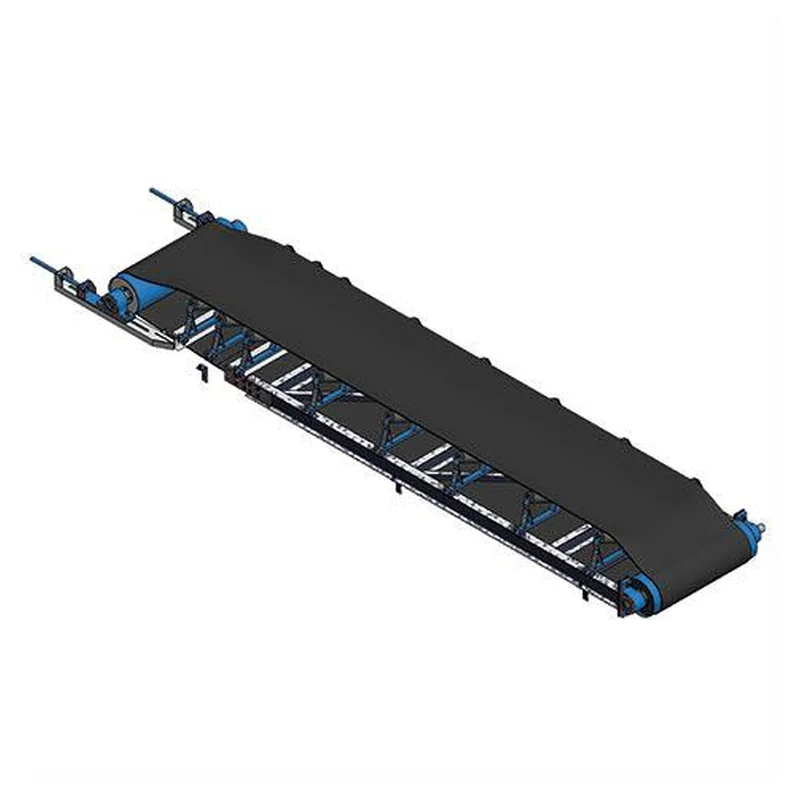
The Rockwell Crusher belt conveyor connects the machines of a production line, carrying material from the crusher to the screen, from the screen to the sand washer, and from every stage to the stockpile. It is built in four widths from 60 to 120 cm and in the length each line requires.
Application
Continuous conveying of rock, sand and gravel between production line machines and transferring final products to stockpiles. The length and layout of each belt conveyor are designed according to your production line layout.
Made by Rockwell Crusher
This machine is fully designed and built in the Rockwell Crusher workshop in Shahr-e Qods. As a result, its spare parts are always available, and our technical team is there for you for installation, commissioning and after-sales service.
How Does a Belt Conveyor Work?
- Material loadingMaterial from the previous machine’s outlet falls onto the start of the belt through a loading chute.
- Belt movementThe electric motor and gearbox turn the drive pulley, and the pulley moves the rubber belt.
- Support on idlersThe belt and its load travel along rows of idlers over the entire length of the route.
- Material dischargeAt the end of the belt, material is discharged onto the next machine or the stockpile.
Rockwell Crusher Belt Conveyor Features
IPE 160 beam chassis
The conveyor frame is made of IPE 160 steel beams so it stays rigid and stable even over long lengths.
Custom length
All models are built in various lengths to suit the production line layout.
Industrial bearings
SN516 series bearing housings with 22216K roller bearings for reliable heavy-duty, continuous operation.
Rubber-lagged pulleys
Pulleys are lagged and vulcanized with rubber to increase their life and efficiency.
Bolted connections
The conveyor structure, motor base, gearbox base, idler stands and loading chute are bolted together for easy installation and relocation.
One-piece shafts and replaceable idlers
One-piece shaft with a locking system on the pulley, and press-fit or replaceable idlers for faster service.
Technical Specifications Table
| Model | Belt width (cm) |
|---|---|
| CV-06 | 60 |
| CV-08 | 80 |
| CV-10 | 100 |
| CV-12 | 120 |
Selectable Options
| Component | Options |
|---|---|
| Belt rubber type | EP 400 · EP 650 · EP 800 |
| Power transmission type | Chain · Belt |
| Drive system | Motor · SN3 gearbox · SN4 gearbox |
| Idler type | Press-fit · Replaceable |
Which Width and Length Should I Choose? Belt width depends on the line capacity and the size of the largest pieces on the belt, and its length depends on the distance and height difference between machines in the line layout. To design a belt conveyor that fits your production line, share your capacity and layout plan with our experts.
General Specifications
Read more: A belt conveyor usually carries the output of the cone crusher to the vibrating screen . To learn about the complete production line layout, see our crusher selection guide .
Belt Conveyor Price Inquiry
For pricing and advice on the width, length and layout of the belt conveyor in your production line, contact Rockwell Crusher’s experts.