




Blog
Hydrocone Gradation Chart: How to Predict Product Gradation from the CSS

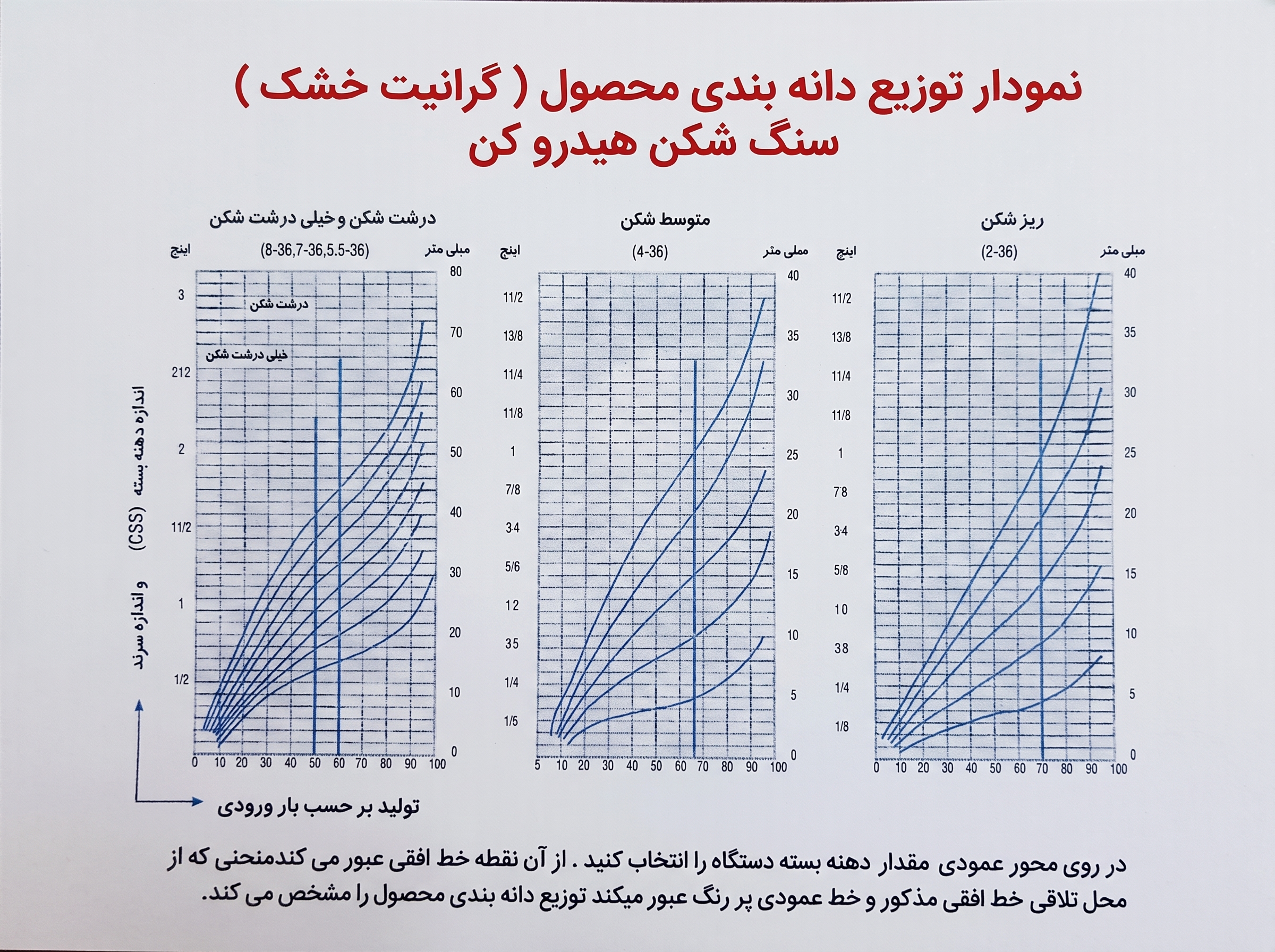
When you buy a cone crusher, tons per hour is only half the story. The real question is how much of the output is the gradation your market needs: chippings, aggregate, sand or road base. The answer is in the hydrocone gradation chart. In this guide we use the actual chart of the Rockwell Crusher 36-inch hydrocone to show how you can predict product gradation from the closed side setting (CSS) before you buy.
What Are Product Gradation and CSS?
Gradation is the share of each particle size in the product, for example what percentage of the output passes a 10 mm screen and what percentage stays on it.
The closed side setting (CSS) is the smallest gap between the mantle and the concave at the bottom of the crushing chamber. It is the most important hydrocone setting because it controls both product size and capacity. On a hydrocone the CSS is adjusted hydraulically, without dismantling any parts.
Gradation Chart of the 36-Inch Hydrocone
The chart has three parts, one for each group of crushing chamber designs:
- Fine (2-36): for fine products with a small CSS.
- Medium (4-36): for intermediate crushing.
- Coarse and extra-coarse (5.5-36, 7-36 and 8-36): for coarser feed and higher capacity.
In each chart the vertical axis shows the CSS and the screen opening in millimetres and inches. The horizontal axis shows the percentage of total product finer than that size (cumulative percent passing). The blue curves are the product gradations at different CSS settings, and the bold vertical line is the reference line of each chart. The data are for dry granite.
How to Read the Gradation Chart, Step by Step
- Find your crusher’s CSS on the vertical axis.
- Move horizontally from that point until you reach the bold vertical line.
- The curve passing through that intersection is your product gradation curve at that CSS.
- Follow that curve: for any screen size on the vertical axis, read the horizontal value. This is the percentage of product that passes that screen.
A simple rule: the bold line of each chart shows the share of product finer than the CSS itself, i.e. roughly how much passes a screen with an opening equal to the CSS:
| Chamber design | Type | Typical CSS (mm) | Share of product finer than CSS |
|---|---|---|---|
| 2-36 | Fine | 8–19 | about 70% |
| 4-36 | Medium | 13–19 | about 65% |
| 5.5-36 | Coarse | 19–22 | about 60–65% |
| 7-36 | Coarse | 25–32 | about 60% |
| 8-36 | Extra coarse | 32 | about 50% |
These figures match the “fines” column in the 36-inch hydrocone production table, where fines are effectively the part of the product finer than the CSS.
Two Worked Examples
Example 1: fine chamber 2-36 at 10 mm CSS
Total capacity is about 65 t/h, and about 45 t/h (close to 70%) is finer than 10 mm. With a 10 mm vibrating screen after the crusher you get about 45 t/h of undersize, while about 20 t/h stays on the screen and is either sold as a coarser product or returned to the crusher in closed circuit.
Example 2: coarse chamber 7-36 at 25 mm CSS
Total capacity is about 145 t/h, and about 87 t/h (close to 60%) is finer than 25 mm. This setting suits lines that need high capacity and a large share of coarser aggregate.
Choosing the CSS: Balancing Capacity and Fineness
- Smaller CSS: finer product, but lower capacity and faster mantle and concave wear.
- Larger CSS: higher capacity, but more of the product stays coarse.
- Eccentric throw: at the same CSS, a longer throw raises capacity but needs a stronger motor. See the full capacity table by CSS and throw on the 36-inch hydrocone page.
- Closed circuit with a screen: instead of closing the CSS too far, it is usually better to screen out the oversize and return it to the crusher.
- Sand production: for more sand with a cubical shape, add a rock-on-rock (VSI) crusher after the hydrocone.
What Changes the Real Gradation?
The chart is for dry granite under standard conditions. In practice these factors change the result:
- Rock type and hardness: softer rock usually gives a finer product.
- Moisture and clay: wet, clayey feed packs the chamber and hurts both capacity and gradation.
- Full, even feed: a choke-fed chamber gives a more consistent gradation and a more cubical shape.
- Scalping fines before the crusher: table values assume that material finer than the CSS has been screened out first.
- Mantle and concave wear: as liners wear the CSS opens and the product gets coarser, so measure and readjust the CSS regularly.
Hydrocone Gradation FAQ
What does a hydrocone gradation chart show?
It shows what percentage of the crusher product is finer than each screen size at a given closed side setting (CSS). It lets you estimate the share of aggregate, sand and oversize before buying or adjusting the crusher.
What does CSS mean on a cone crusher?
CSS, the closed side setting, is the smallest gap between the mantle and concave at the bottom of the crushing chamber. A smaller CSS gives a finer product and lower capacity.
What share of hydrocone output is finer than the CSS?
For the 36-inch hydrocone on dry granite, it is about 70% for the fine chamber, about 65% for the medium chamber, about 60% for the coarse chamber and about 50% for the extra-coarse chamber.
Which hydrocone chamber is best for fine aggregate?
The fine chamber (2-36) with a CSS of 8 to 19 mm gives the largest share of fine product. For a high sand yield, a rock-on-rock (VSI) crusher is usually added after the hydrocone.
Why does the real gradation differ from the chart?
The chart is for dry granite. Rock hardness and moisture, feed uniformity, scalping of fines before the crusher and liner wear all change the actual gradation.
Does Rockwell Crusher help choose the CSS and chamber?
Yes. Share your rock type, feed size and required product with Rockwell Crusher’s team and we will recommend the chamber design, CSS and eccentric throw.
Get Expert Advice
Rockwell Crusher builds 36-inch and 45-inch hydrocones and their spare parts in its own workshop. See the 36-inch hydrocone and the 45-inch hydrocone, read our crusher selection guide, or call +98 912 133 3594.