



Blog
What Is a Hydrocone? Complete Guide to the Hydraulic Cone Crusher: Working, Parts, Specs and Price

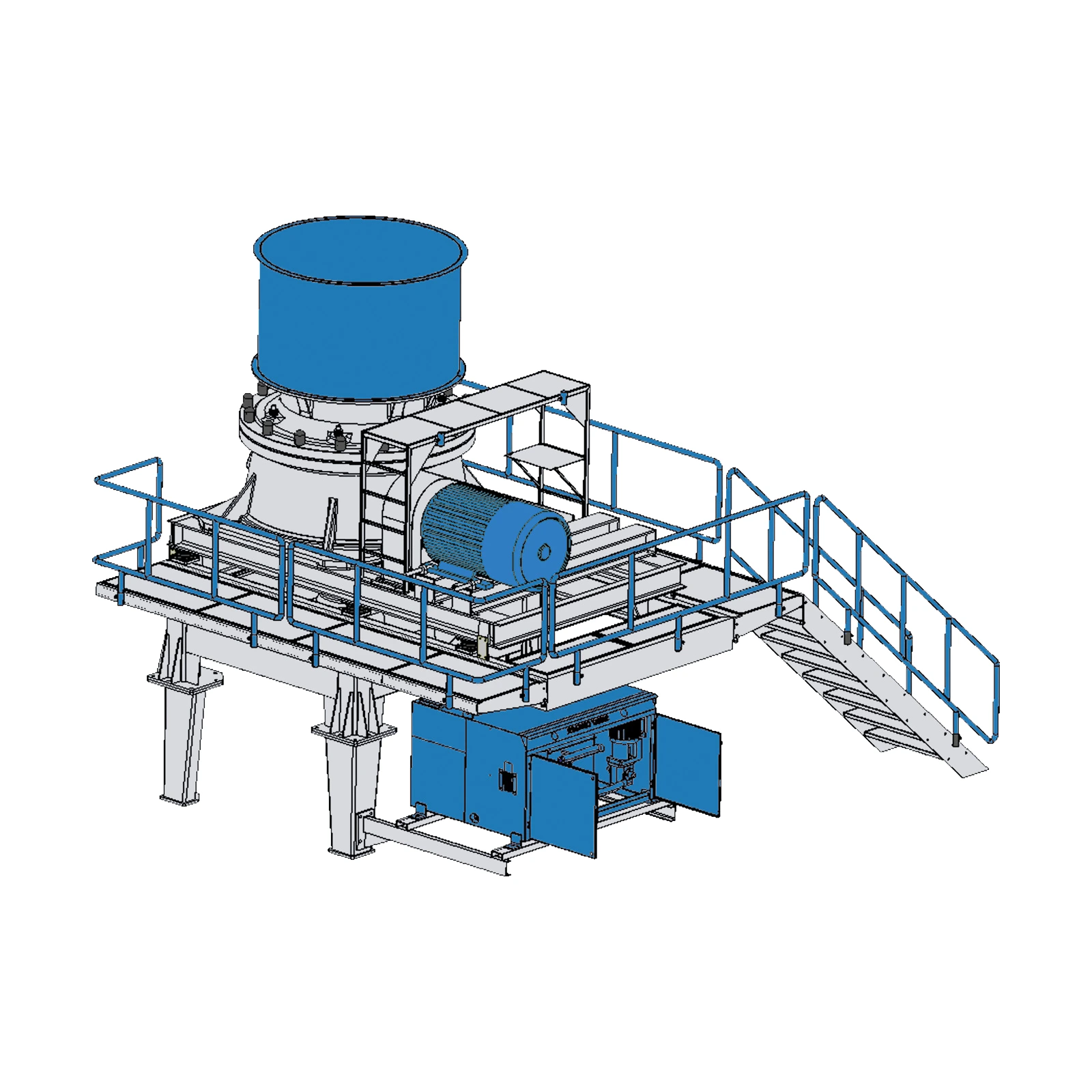
A hydrocone, or hydraulic cone crusher, is the most widely used machine for secondary and final crushing in aggregate plants and mines. Whether you want to buy a hydrocone, source its spare parts or improve the output of your plant, this guide explains everything in plain language: how it works, its main parts, chamber selection, gradation control, maintenance and what drives the price. It is based on Rockwell Crusher’s experience building hydrocones and their spare parts.
What Is a Hydrocone?
A hydrocone is a type of cone crusher in which the discharge setting and the overload protection are controlled by a hydraulic system. The name combines “hydraulic” and “cone”. In many markets, including Iran and the Middle East, any hydraulic cone crusher is simply called a hydrocone.
Inside a hydrocone, a cone-shaped part called the mantle sits inside a fixed bowl called the concave. The mantle moves in an eccentric gyrating motion, and rock is squeezed and crushed between the mantle and the concave. A hydrocone usually follows a jaw crusher in the plant and turns its coarse output into aggregate with an accurate gradation.
| Feature | Description |
|---|---|
| Other names | Hydraulic cone crusher, cone crusher, hydrocone |
| Crushing stage | Secondary and tertiary (final) |
| Crushing method | Compression between mantle and concave |
| Suitable rock | Hard and abrasive: granite, basalt, river gravel, iron ore |
| Gradation control | By chamber type and discharge setting (CSS) |
| Rockwell Crusher models | 36-inch hydrocone and 45-inch cone crusher (hydrocone) |
How Does a Hydrocone Work?
The principle is simple, but the precision of the parts has a direct effect on capacity and product quality. Crushing in a hydrocone happens in these steps:
- Feed: rock enters the ring-shaped space between the mantle and the concave from the feed hopper on top.
- Gyrating mantle: the main shaft sits in an eccentric bushing. As the eccentric turns, the mantle moves towards one side of the concave and away from the other.
- Compression crushing: rock is squeezed and broken where the mantle closes on the concave, then drops a little lower during the next half turn.
- Discharge: after several compression cycles the rock leaves through the bottom opening. The largest product size depends on the gap between mantle and concave at its closest point, the CSS.
Because crushing happens continuously all around the chamber, a hydrocone has a high capacity for its size and produces a uniform gradation.
The Role of the Hydraulic System
The main difference between a hydrocone and older cone crushers is the hydraulic system. In a hydrocone, the main shaft rests on a hydraulic cylinder, and this system does three important jobs:
Fast discharge setting adjustment
By pumping oil under the cylinder or releasing it, the shaft and mantle move up or down and the CSS changes without a long stop and without opening the crusher. As the mantle and concave wear, the operator can reset the gap to keep the gradation constant.
Overload protection
If tramp iron or an uncrushable object enters the chamber, hydraulic pressure rises, the mantle drops and the object passes through. The mantle then returns to its setting automatically. This protects the shaft, frame and expensive parts from breaking.
Clearing the chamber after a stop
If the crusher stops under load, lowering the mantle frees the crushing chamber, so it can be restarted without emptying the chamber by hand.
Main Parts of a Hydrocone
Knowing the parts of a hydrocone is essential for proper maintenance and for ordering spare parts on time:
| Part | Function |
|---|---|
| Mantle (inner cone) | Wear liner on the head of the main shaft that presses rock against the concave |
| Concave (outer bowl) | Wear liner inside the top shell that forms the fixed crushing surface |
| Top shell | Holds the concave and the spider; sits on top of the crusher |
| Spider | Top arm that supports the upper end of the main shaft |
| Bottom shell and housing | Main frame that holds the eccentric, countershaft and hydraulic cylinder |
| Main shaft | Carries the mantle and transfers the gyrating motion to it |
| Eccentric bushing | Turns rotation into the eccentric motion of the mantle |
| Countershaft, pinion and bevel gear | Transfer power from the electric motor, via belts, to the eccentric |
| Hydraulic cylinder and power unit | CSS adjustment, overload protection and chamber clearing |
| Lubrication system | Lubricates and cools bushings, bearings and gears |
Hydrocone Crushing Chambers and How to Choose One
A key advantage of a hydrocone is that changing the mantle and concave changes the shape of the crushing chamber, so one machine can serve different jobs. Coarse chambers take larger feed, while fine chambers suit fine aggregate and feed for a sand-making crusher. The table shows the chambers of the Rockwell Crusher 45-inch hydrocone:
| Chamber | Total capacity (t/h) | Typical use |
|---|---|---|
| EC (extra coarse) | 250 | Secondary crushing of coarse jaw crusher output |
| C (coarse) | 220 | High-capacity secondary crushing |
| M (medium) | 220 | Aggregate production and feed for the next stage |
| F (fine) | 170 | Fine aggregate and feed for a sand-making crusher |
| EF (extra fine) | 150 | Very fine material |
The general rule is that the largest feed lump must not exceed the chamber’s maximum feed size, and the chamber should match your required CSS as closely as possible.
Gradation Control: What Is the CSS?
The CSS (closed side setting) is the smallest gap between the mantle and the concave at the bottom of the chamber. A smaller CSS gives a finer product but lowers capacity; a larger CSS gives more capacity and a coarser product. The table shows the capacity of the Rockwell Crusher 45-inch hydrocone in several chambers and settings (t/h):
To see exactly what gradation each CSS produces, read our guide to reading the hydrocone gradation chart, with a real chart and worked examples.
| Chamber | CSS 13 mm | CSS 19 mm | CSS 25 mm | CSS 38 mm |
|---|---|---|---|---|
| EC (extra coarse) | – | 122–276 | 139–313 | 175–395 |
| C (coarse) | – | 117–292 | 133–332 | 167–335 |
| M (medium) | 117–187 | 136–298 | 154–339 | 194 |
| F (fine) | 104–191 | 120–221 | 137–251 | – |
For a stable output, follow these points in addition to setting the CSS:
- Choke feeding: the chamber should always be full of rock. Low or irregular feed makes the mantle and concave wear unevenly and upsets the gradation.
- Even distribution: feed should enter at the center and spread evenly around the chamber.
- Remove fines from the feed: screen out material already smaller than the CSS before the hydrocone so capacity is not wasted.
- Compensate for wear: as liners wear the CSS opens up; measure and reset it regularly with the hydraulic system.
Rockwell Crusher Hydrocone Specifications
Rockwell Crusher builds hydrocones in two sizes, 36-inch and 45-inch. Both are designed and built entirely in our workshop in Shahr-e Qods, Tehran:
| Specification | 36-inch hydrocone | 45-inch hydrocone |
|---|---|---|
| Capacity | 60–165 t/h | 150–250 t/h |
| Range | 5 models | 5 crushing chambers |
| Max. feed size | Depends on model | Depends on chamber |
| Motor power | 90 kW | Depends on chamber and application |
| Weight | 11 t | 23 t |
| Best suited for | Medium-capacity plants | High-capacity plants |
| Product page | 36-inch hydrocone | 45-inch hydrocone |
Hydrocone Applications
- Sand and aggregate production: chippings, gravel and sand-maker feed for concrete and asphalt.
- Metal mining: secondary and tertiary crushing of iron, copper and gold ore before grinding.
- Industrial minerals: crushing hard rock such as granite, basalt and quartz.
- Road building and ballast: base course material and railway ballast with a controlled gradation.
Advantages and Limitations of a Hydrocone
Advantages
- Suited to hard and abrasive rock, with less wear than an impact crusher
- Fast and accurate gradation control with the hydraulic system
- Automatic protection against tramp iron and overload
- High capacity for its size
- Can be adapted to new jobs by changing the crushing chamber
- Uniform gradation and low cost per ton
Limitations
- Not suited to very large run-of-mine rock; needs a jaw crusher before it
- Sensitive to choke and even feeding
- Not suited to very wet and sticky material
- Particles are less cubical than those from a VSI crusher
Hydrocone vs Other Crushers
Hydrocone vs spring cone crusher vs gyratory crusher
| Feature | Hydrocone (hydraulic cone) | Spring cone (Symons type) | Gyratory |
|---|---|---|---|
| Setting adjustment | Hydraulic, fast, during operation | Mechanical, with the crusher stopped | Hydraulic or mechanical |
| Tramp iron protection | Hydraulic cylinder with automatic return | Springs around the frame | Depends on design |
| Feed size | Medium | Medium | Coarse |
| Position in the plant | Secondary and tertiary | Secondary and tertiary | Primary or secondary on coarse rock |
| Gradation accuracy | High | Medium | Medium |
To learn more about gyratory crushers, read our gyratory crusher buying guide.
Hydrocone vs jaw crusher
| Feature | Hydrocone | Jaw crusher |
|---|---|---|
| Crushing stage | Secondary and final | Primary |
| Feed size | Up to about 200 mm | Up to about 1150 mm |
| Motion | Eccentric gyration of the mantle | Reciprocating movable jaw |
| Product gradation | Finer and more uniform | Coarse |
| Role in the plant | Usually after the jaw crusher | First machine in the plant |
In most plants, a hydrocone and a jaw crusher work one after the other rather than competing. To compare all crusher types, see our crusher selection guide.
Where the Hydrocone Fits in a Sand and Gravel Plant
- Feeder and jaw crusher: run-of-mine rock is broken down.
- Screen: material already finer than needed is removed.
- Hydrocone: jaw crusher output is turned into aggregate with an accurate gradation.
- Vibrating screen: the product is sized and oversize returns to the hydrocone.
- Sand maker: to make manufactured sand, part of the product goes to the rock-on-rock (VSI) crusher.
Hydrocone Spare Parts Made by Rockwell Crusher
A hydrocone is a precision machine, and the quality of its spare parts directly affects its life and capacity. A major advantage of Rockwell Crusher is that we make hydrocone spare parts ourselves, so parts arrive with accurate dimensions, quickly and without middlemen. For liner materials, wear life and replacement timing, see our article on the hydrocone mantle and concave. The main hydrocone spare parts are:
- Mantle and concave (manganese steel wear liners)
- Top shell, bottom shell and housing
- Spider and spider bushing
- Main shaft and eccentric
- Bushings and bearings
- Pinion, bevel gear and countershaft
- Hydraulic cylinder and power unit parts
- Seals and lubrication system parts
Hydrocone Maintenance and Repair
Regular maintenance multiplies the life of a hydrocone and lowers the cost per ton. Our full guide to troubleshooting, routine service and overhauls is in the article on hydrocone repair. The main maintenance tasks are:
- Daily checks of lube oil temperature and pressure, and filter condition
- Checking hydraulic pressure and cylinder leaks
- Regular CSS measurement and adjustment as liners wear
- Inspecting the mantle and concave and replacing them before minimum thickness
- Checking belt tension and listening for abnormal gear noise
- Keeping tramp iron out with a magnet over the feed conveyor
| Common problem | Likely cause | Solution |
|---|---|---|
| Oil overheating | Dirty filter or cooler, wrong oil, worn bushing | Clean or replace filter and cooler, change oil, inspect bushings |
| Product getting coarser | Mantle and concave wear, CSS opening up | Reset the CSS hydraulically, replace liners |
| Mantle dropping repeatedly | Tramp iron or overfeeding, loss of hydraulic pressure | Install a magnet, adjust the feeder, check cylinder and seals |
| Vibration and abnormal noise | Uneven feed, loose parts, gear wear | Even out the feed, inspect and repair gears |
| Loss of capacity | Insufficient feed, too many fines in the feed, CSS too small | Choke feed, screen the feed, review CSS and chamber |
What Determines the Price of a Hydrocone?
- Size and capacity: a 45-inch hydrocone costs more than a 36-inch because of its weight and capacity.
- Chamber type and liner quality: the manganese content and casting quality of the mantle and concave decide your wear costs in later years.
- Hydraulic and lubrication systems: their quality affects both the price and the reliability of the machine.
- Electric motor and accessories: motor type, base frame and control panel.
- Installation and after-sales service: include transport, installation, commissioning and spare parts availability when comparing prices.
Rockwell Crusher builds hydrocones directly in its own workshop, with no middlemen. For a hydrocone quotation, send our team your rock type, required capacity, largest feed size and target gradation.
Tips for Buying a Hydrocone
- Define your plant’s required capacity and gradation, and choose the chamber accordingly.
- Make sure the largest feed lump does not exceed the chamber’s maximum feed size.
- Ask about the material and quality of the mantle, concave and hydraulic system.
- Choose a manufacturer that makes hydrocone spare parts itself or can supply them quickly.
- Put installation, commissioning, operator training and after-sales service in the contract.
- If possible, visit the manufacturer’s workshop and machines in operation.
To buy a cone crusher (hydrocone) directly from the manufacturer, see the specifications of our two models on the 45-inch cone crusher and 36-inch hydrocone pages. Hydrocone spare parts, from the mantle and concave to bushings and eccentrics, are made in our own workshop. Call us on +98 912 133 3594.
Hydrocone FAQ
What is a hydrocone?
A hydrocone is a cone crusher whose discharge setting and overload protection are controlled by a hydraulic system. It is used for secondary and final crushing of hard rock.
What is the difference between a hydrocone and a cone crusher?
A hydrocone is a type of cone crusher. The name is used for cone crushers with a hydraulic system; older designs use springs instead of hydraulics for overload protection.
How can I make the hydrocone product finer?
Reduce the CSS with the hydraulic system, use a finer chamber (such as F or EF) and keep the crusher choke-fed and evenly fed. A smaller CSS also reduces capacity.
What is the capacity of a hydrocone?
At Rockwell Crusher, the 36-inch hydrocone handles 60 to 165 t/h and the 45-inch hydrocone 150 to 250 t/h. Real capacity depends on the chamber, the CSS and the type of rock.
Which rocks is a hydrocone suitable for?
Hard and abrasive rock such as granite, basalt, river gravel and iron ore. Very wet and sticky material needs to be checked case by case.
How often are the hydrocone mantle and concave replaced?
It depends on rock abrasiveness, operating hours and the quality of the manganese steel. Replace them when gradation and capacity can no longer be held after hydraulic adjustment, or when the liner reaches its minimum thickness.
How is a hydrocone repaired?
Most hydrocone repairs involve replacing the mantle and concave, bushings, bearings and gears, and servicing the lubrication and hydraulic systems. The work should be done with precise parts by a team that knows the machine.
Does Rockwell Crusher make hydrocone spare parts?
Yes. Besides building 36-inch and 45-inch hydrocones, Rockwell Crusher makes their spare parts in its own workshop and supports customers with installation, repair and after-sales service.